Digital advertising no longer works on manual deals, static placements, or guesswork. Every time a user loads a page or opens an app, an invisible, lightning-fast auction decides which ad they see and which advertiser wins that attention.
This is where Real-Time Bidding (RTB) and programmatic buying come in. These two concepts power the modern ad ecosystem, but they are often confused or used as if they mean the same thing.
In reality, you must continue reading to undestand how they differ and how each impact the efficiently you can scale campaigns, control costs, and reach the right audience at the right moment.
TL;DR
- RTB (Real-Time Bidding) is an auction-based system where ad impressions are bought and sold in real time.
- Programmatic Buying is the broader automated process of purchasing digital ad inventory using technology and data.
- RTB is a subset of programmatic advertising.
- Both improve targeting, efficiency, and scalability compared to manual ad buying.
What Is Real-Time Bidding?
Real-Time Bidding (RTB) is an automated auction process where digital ad impressions are sold individually in real time.
When a user visits a website or app, an instant auction takes place among advertisers, and the highest bidder wins the impression.
RTB allows advertisers to bid on specific users rather than broad placements, making advertising more precise and performance-focused.
How does RTB work?
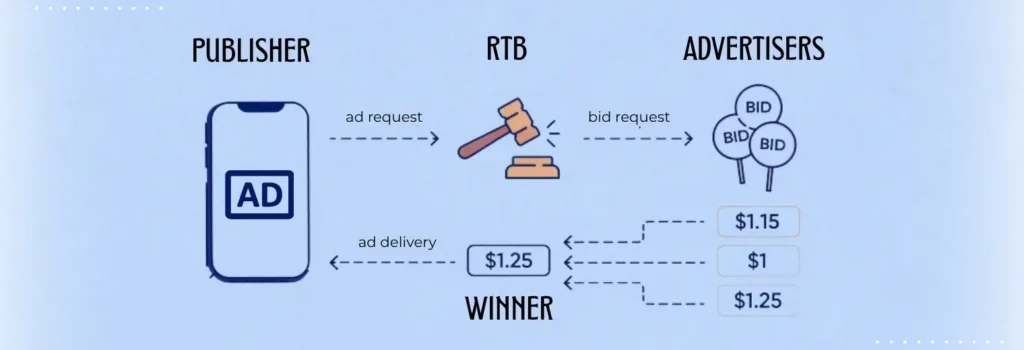
RTB happens in milliseconds through the following process:
- A user visits a website or app
- The publisher sends an ad request to an ad exchange
- The ad exchange broadcasts the impression to advertisers
- Advertisers bid based on user data (location, behavior, device, etc.)
- The highest bidder wins
- The winning ad is instantly displayed
All of this happens before the page fully loads, making RTB extremely fast and automated.
Advantages of RTB
RTB offers several key benefits:
- Highly targeted advertising based on real user data
- Efficient use of ad budgets
- Real-time optimization and bidding decisions
- Access to large-scale inventory across the web
- Improved ROI through data-driven bidding
What Is Programmatic Buying?
Programmatic Buying is the automated process of purchasing digital advertising using software, algorithms, and data.
It goes beyond real-time auctions and includes multiple types of automated ad buying methods, such as RTB, private marketplaces, and programmatic direct deals.
In simple terms, RTB is one part of the larger programmatic ecosystem.
How does Programmatic Buying Work?
Programmatic buying uses platforms like DSPs (Demand-Side Platforms) and SSPs (Supply-Side Platforms) to automate the entire ad purchasing process.
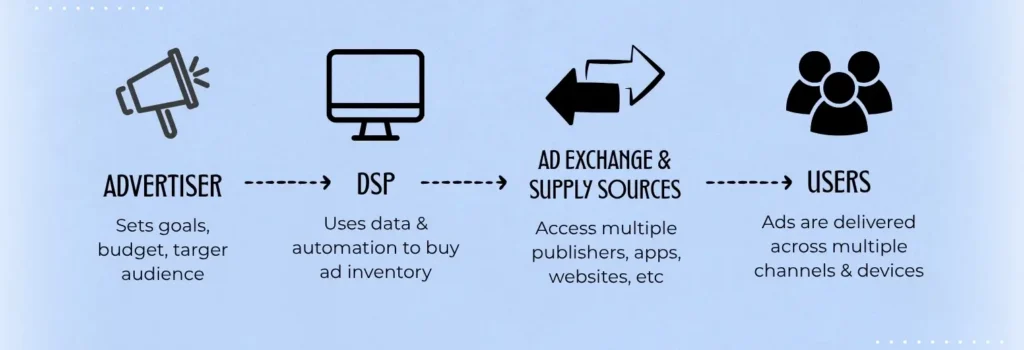
- Advertisers define targeting, budget, and campaign goals in a DSP
- The DSP connects to multiple ad exchanges and inventory sources
- The system automatically matches ads with relevant audiences
- Ads are served based on real-time or pre-negotiated conditions
- Performance is continuously optimized using data and algorithms
Unlike RTB-only systems, programmatic buying can also include fixed-price deals.
Programmatic buying connects multiple technologies:
Rather than negotiating ad placements manually, programmatic buying uses software to automate the buying and selling of digital ad inventory in real time. Behind every ad impression, several platforms work together in milliseconds, from identifying the right audience to running the auction to delivering the final creative.
| Term | Description |
|---|---|
| DSP (Demand-Side Platform) | Used by advertisers to buy inventory |
| SSP (Supply-Side Platform) | Used by publishers to sell inventory |
| Ad Exchange | Marketplace where auctions occur |
| DMP/CDP | Audience and data management |
| Ad Server | Delivers and tracks creatives |
Understanding these core components is the first step to understanding how the entire ecosystem fits together.
Advantages of Programmatic Buying for Advertisers & Publishers
Programmatic advertising offers broader advantages than RTB alone:
- Full automation of ad buying and placement
- Access to multiple inventory types (open web, private deals, direct buys)
- Advanced audience targeting and segmentation
- Cross-channel scalability (display, video, mobile, CTV)
- Real-time data optimization and reporting
| Aspect | Perks for Advertisers | Perks for Publishers |
|---|---|---|
| Efficiency | Automated buying replaces manual media negotiations | Automated selling reduces need for direct sales efforts |
| Targeting | Precise audience targeting using behavioral, demographic, and intent data | Better matching of inventory with high-value demand sources |
| Revenue/ROI | Higher ROI through reduced wasted impressions and smarter bidding | Higher revenue via competitive real-time auctions and yield optimization |
| Scale | Access to global inventory through a single platform | Access to global advertiser demand across multiple DSPs |
| Optimization | Real-time bidding adjusts campaigns dynamically for performance | Yield management tools maximize value per impression |
| Control | Full control over budgets, bids, and performance rules | Control over floor prices, ad quality, and monetization rules |
| Reporting | Granular insights into conversions, placements, and audiences | Detailed analytics on inventory performance and revenue trends |
| Automation | AI-driven bidding, pacing, and budget allocation | Automated fill and monetization of unsold inventory |
| Formats | Cross-channel delivery (display, video, mobile, CTV, native) | Monetization across multiple formats (display, video, native, mobile, dynamics, CTV) |
| Fraud & safety | Brand safety controls and fraud prevention tools | Traffic quality filters and invalid traffic protection systems |
RTB vs Programmatic Buying
If you’ve come this far, you already know Real-Time Bidding (RTB) and programmatic advertising are closely related, but they are not the same thing.
- RTB is a specific buying method, while programmatic advertising is the broader ecosystem that automates digital ad buying across multiple channels and deal types.
RTB is an auction-based system where individual ad impressions are bought and sold in real time. Every time a user loads a page or app, advertisers compete in a split-second auction, and the highest bidder wins the impression. This makes RTB highly dynamic, data-driven, and focused on real-time decision-making.
- Programmatic advertising, on the other hand, includes RTB but goes beyond it. It covers all automated ad buying methods, including real-time auctions, private marketplaces (PMPs), and programmatic direct deals.
Instead of relying only on auctions, programmatic allows advertisers to access inventory through multiple pricing and purchasing models using platforms like DSPs and SSPs.
| Feature | RTB | Programmatic Buying |
|---|---|---|
| Definition | Real-time auction for impressions | Automated digital ad buying system |
| Scope | Narrow | Broad |
| Buying method | Auction-based only | Auctions + direct deals |
| Speed | Milliseconds | Milliseconds + scheduled deals |
| Flexibility | Limited to auctions | Multiple buying models |
| Relationship | Subset | Parent system |
The key difference is scope. RTB is a single transaction method based on bidding in real time, while programmatic is the entire system that enables automated media buying at scale.
In simple terms, RTB is the auction engine, and programmatic is the full infrastructure that powers modern digital advertising.
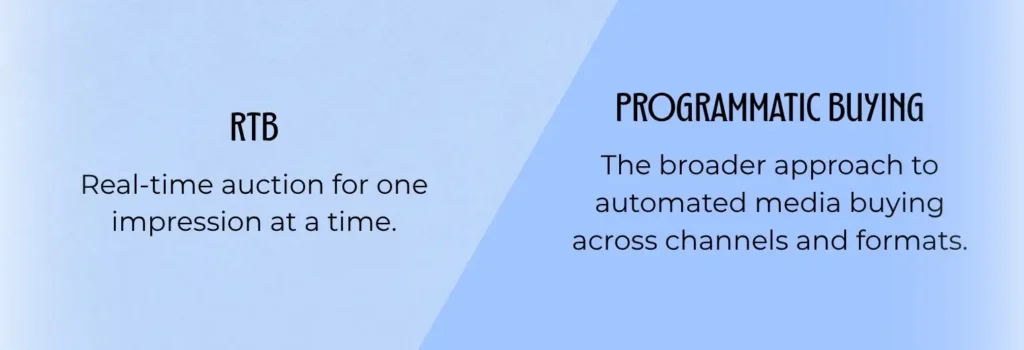
Key Takeaway:
- RTB is the auction engine.
- Programmatic advertising is the full operating system that manages audience targeting, bidding, optimization, reporting, and inventory access.
Privacy Changes & Cookieless Targeting
Programmatic advertising is changing because browser privacy restrictions are reducing access to third-party tracking signals.
Key industry shifts include:
- Chrome Privacy Sandbox rollout
- Apple App Tracking Transparency (ATT)
- GDPR enforcement
- increased consent management requirements
- contextual targeting resurgence
- first-party data adoption
How Advertisers Are Adapting
For affiliates and performance marketers, this means targeting quality increasingly depends on traffic source quality and conversion signal accuracy.
How Affiliates and Advertisers Use Programmatic Traffic
Different buyer types use programmatic inventory differently.
| Affiliates & Performance Marketers | Brands & Advertisers |
|---|---|
| Scalable acquisition costs | Audience quality |
| Rapid creative testing | Brand safety |
| Broad GEO reach | Viewability |
| High-volume traffic sources | Attribution accuracy |
| Optimization flexibility | Premium inventory |
RTB & Programmatic: Current Market Dynamics
The digital advertising landscape continues to shift toward automation and data-driven decision-making.
- Increased adoption of AI-driven bidding strategies
Advertisers are increasingly using AI and machine learning to optimize bidding decisions in real time, improving targeting accuracy, reducing wasted spend, and maximizing ROI across programmatic campaigns. - Stronger focus on first-party data due to privacy changes
With third-party cookies being phased out, advertisers are relying more on first-party data collected directly from users to maintain accurate targeting and campaign performance. - Rising demand for transparency in ad supply chains
Advertisers are demanding clearer visibility into where ads are shown, how budgets are distributed, and which intermediaries are involved to reduce fraud and improve trust. - Shift toward cookieless targeting solutions
As cookies are deprecated, the industry is moving toward contextual targeting, cohort-based models, and privacy-friendly identifiers to continue delivering relevant ads without tracking users directly.
As a result, programmatic buying is becoming the default standard for digital media purchasing, while RTB remains a core execution layer.
Programmatic vs RTB FAQ
No. RTB is only one part of programmatic advertising.
It improves efficiency, targeting, and scalability by automating ad buying decisions.
Programmatic is broader and more flexible, while RTB is ideal for real-time auction-based buying.
A DSP (Demand-Side Platform) helps advertisers buy inventory and optimize campaigns. An SSP (Supply-Side Platform) helps publishers sell inventory, manage pricing, and maximize revenue across multiple demand sources and exchanges.
Privacy regulations and browser restrictions reduce reliance on third-party cookies and cross-site tracking. Advertisers increasingly use first-party data, contextual targeting, consent-based attribution, and server-side tracking to maintain targeting and measurement accuracy.
Yes, especially for affiliates running scalable acquisition campaigns across native, push, display, or pop traffic. However, profitability depends heavily on traffic quality, conversion tracking accuracy, bidding strategy, and GEO-specific optimization.
Make Money With Mondiad!
Whether you’re scaling affiliate campaigns, testing new GEOs, or optimizing programmatic acquisition costs, traffic quality and bidding efficiency matter more than broad reach alone.
Mondiad gives advertisers access to:
- push, native, banner, and pop traffic
- advanced targeting controls
- real-time optimization tools
- global inventory access
- performance-focused campaign management