Which ad format is the best? If this question had a universal answer, the world of digital advertising would look so different. However, we can answer this question if we add to it and make it sound like this: Which ad format is best for my goal? And here is where the picture starts to get clear.
What is the reason you want to advertise? Is it brand awareness, driving conversions, do you have a new product to launch, is it an offer in the dating niche?… You get the gist. The more specific you are, the better you can make choices regarding parameters for your ad campaign.
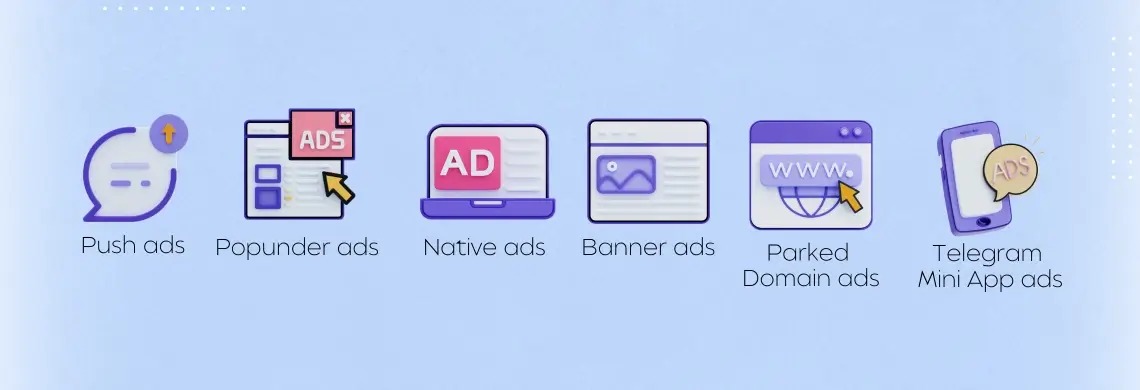
With this in mind, let’s explore the advertising possibilities that Mondiad ad formats bring to the table.
TL;DR
There’s no single “best” ad format, only the one that best matches your campaign goals. Choose your format based on your objective, audience, budget, and niche, then validate your decision with testing and data. Push, native, banner, interstitial, pop, video, and social media ads each have strengths, and the highest-performing advertisers continuously optimize based on real campaign results.
How to Select the Right Ad Formats
🔹 To start, the performance of your ad campaign is not based exclusively on your ad format of choice. Campaign performance is widely affected by factors such as your niche, target audience, competition, ad quality, and current trends.
Moreover, different niches have distinct characteristics which necessitate tailored strategies to resonate effectively. So before selecting an ad format, it is important to do your research and make sure you understand the market and your audience as best as you can. For example, it is commonly known that men are more into gadgets while women like fashion.
🔹 Moving on, to determine which ad type is working better for your campaign, you must have a clear goal. Is it brand awareness, lead generation, website traffic, customer retention or something else? Establishing well-defined objectives will help you better understand your advertising efforts and measure it via relevant metrics.
🔹 And last but not least on our list of recommendations, let’s not forget the budget considerations. Ad formats have different prices due to their complexity, demand, and the platforms on which they are displayed. As each ad format comes with varying costs, this is another vital element you must take note of in the final decision-making process.
🔹 Look around. Search for recent case studies and industry reports showcasing success with your ad campaign that are similar in nature with yours. You can check on active forums or other relevant channels. Additionally, you should get updated on the latest marketing insights regarding which ad types are currently performing well… Or ask your Mondiad account manager.
🔹 Test each ad format available to understand which one is working better for you. If you find that one ad format consistently outperforms others, allocate more resources to it and if an ad format isn’t delivering the expected results, consider adjustments or trying a different format.
🔹 Monitor metrics such as click-through rates, conversion rates, engagement, and return on investment (ROI). Analyse the results to determine which format yields the best results for your specific goals.
Test ad formats for at least 2 weeks, then check the reports section (you can make a breakdown by ad format) to see which one is working best for you.
Modern Ad Formats
Classic Push Ads
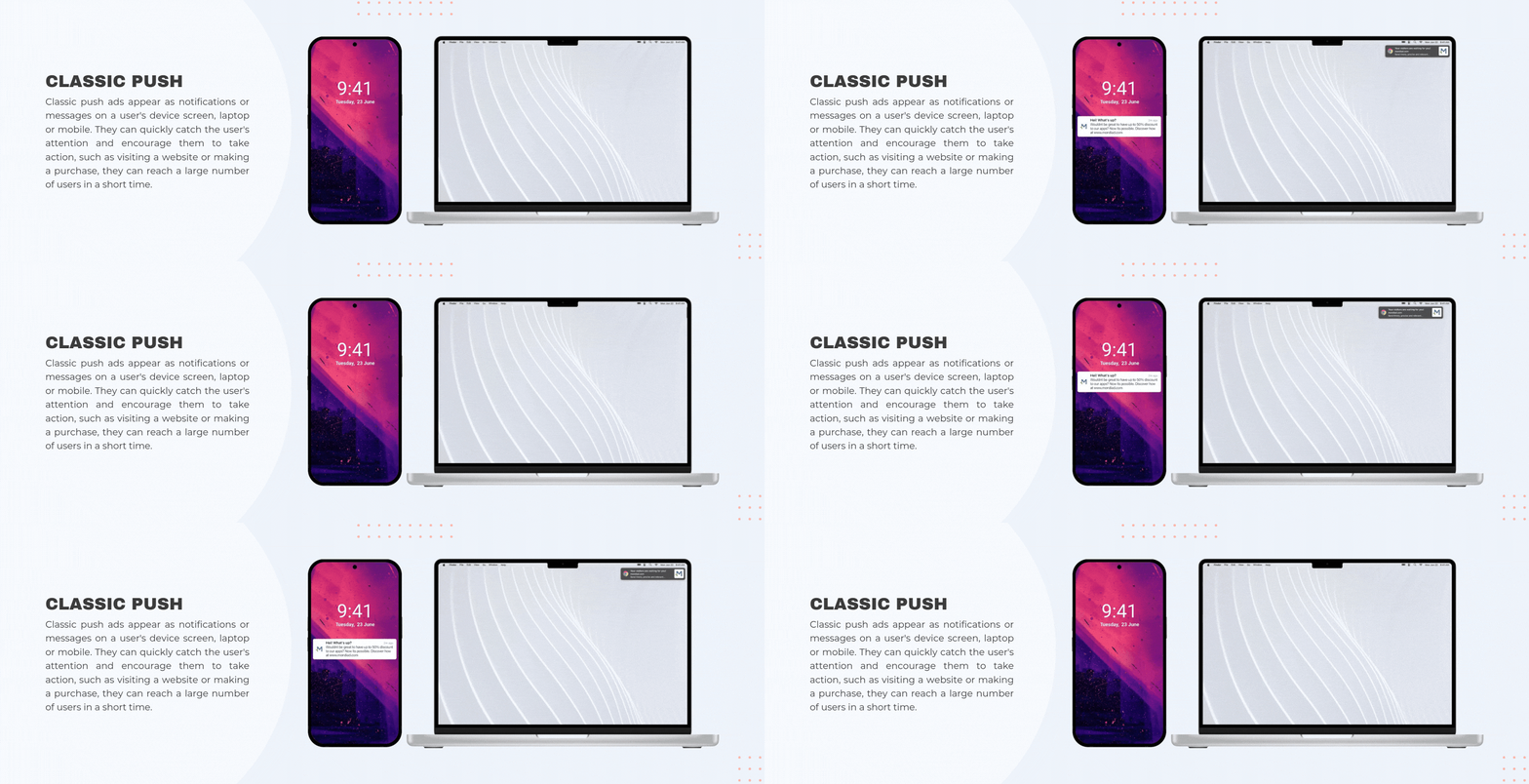
Classic push ads appear as notifications or messages on a user’s device screen, laptop or mobile. They can quickly catch the user’s attention and encourage them to take action, such as visiting a website or making a purchase. They can reach a large number of users in a short amount of time.
The ad format’s directness and immediate visibility make it Ideal for promoting time-sensitive offers or updates. Success also depends on factors such as relevance, user engagement, and timing.
Target audience: Suitable for a wide range of audiences due to their broad reach
Mondiad’s successful verticals: e-commerce, finance, dating.
In-page push
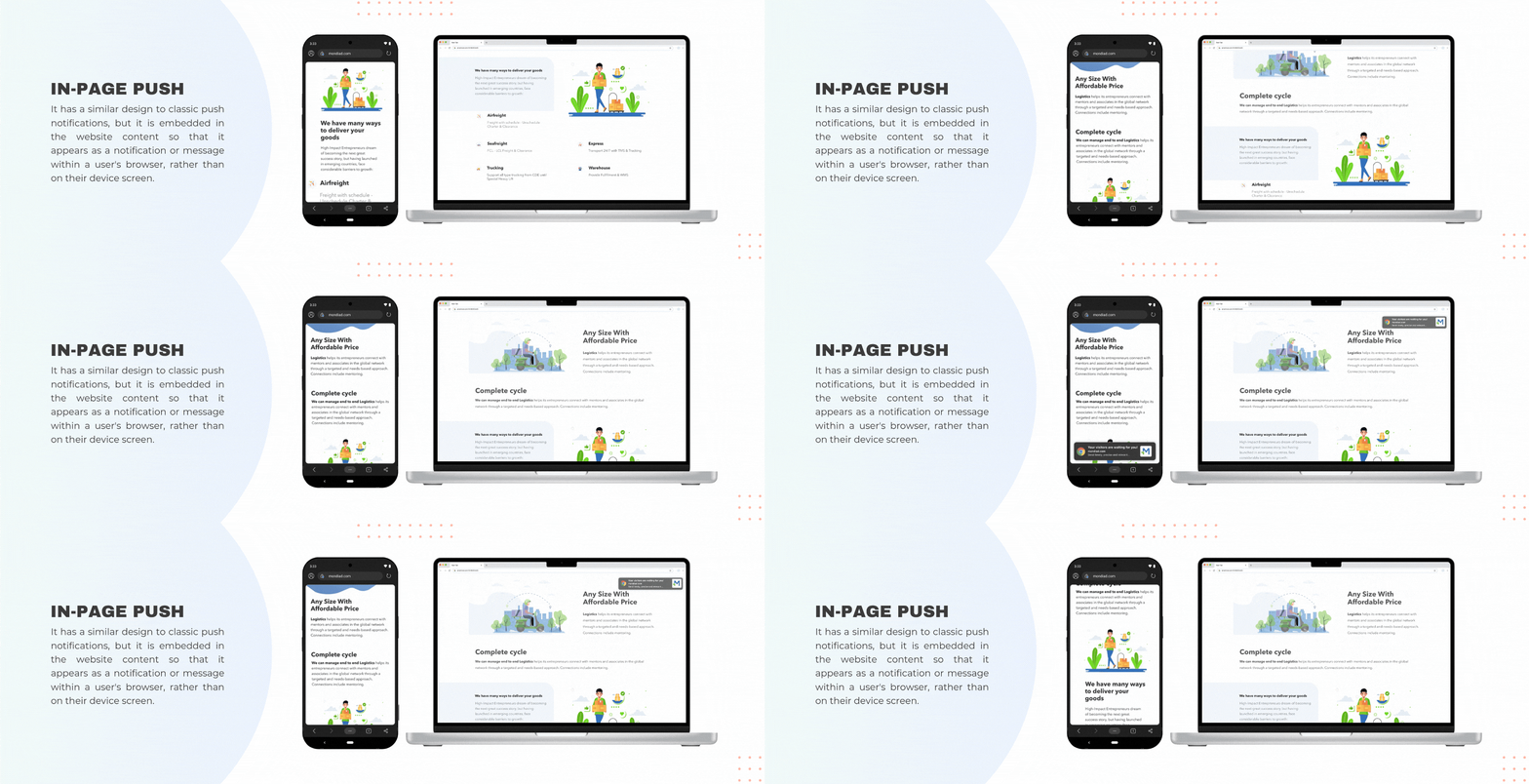
Similar in design to classic push notifications, the in-page format is embedded in the website content, showing up as a browser notification or message rather than a device screen. In-page push ads can reach visitors across all devices, all OS, and browser types.
Target audience: Suitable for users who have consented to receive browser notifications, usually from websites they’ve visited.
Mondiad’s successful verticals: Well-suited for content-driven websites, news platforms, blogs, and e-commerce sites.
Native Ads
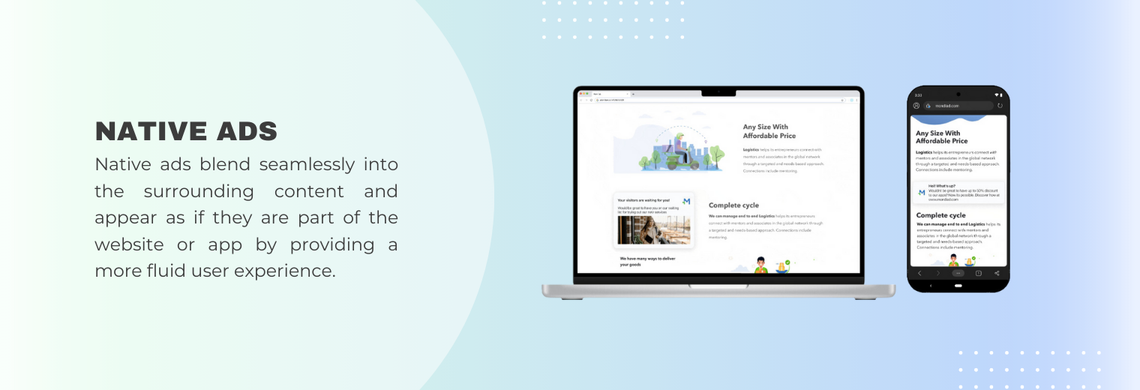
Native ads blend seamlessly in with the content and style of the platform on which they are displayed, being less disruptive and more engaging than traditional display ads.
Target audience: Appeals to users who prefer a more integrated and less promotional ad format.
Mondiad’s successful verticals: Effective for brands promoting products or services that align with the platform’s content: beauty & fashion, travel, news, health & wellness, technology or finance.
Banner Ads
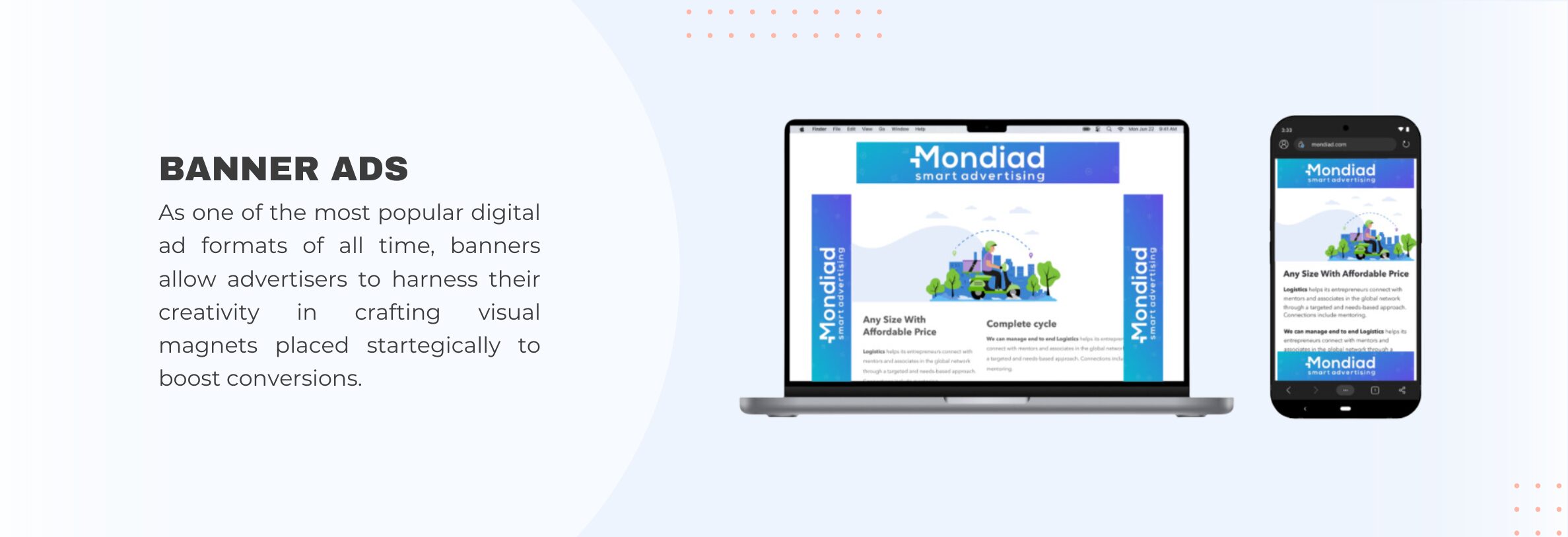
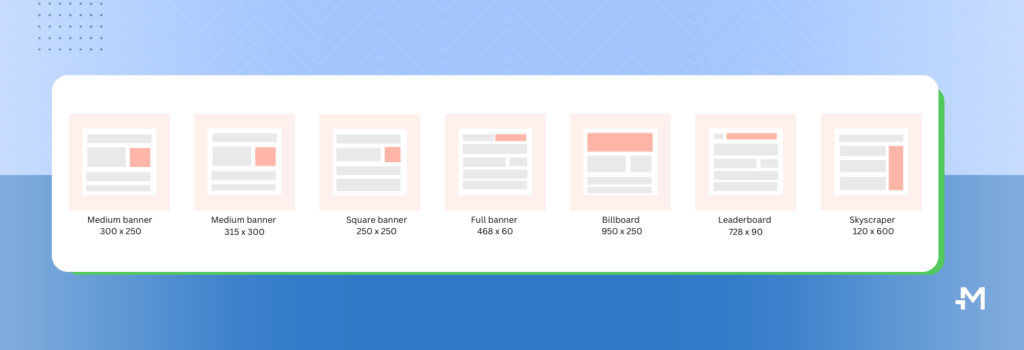
Designed to capture the viewer’s attention, banner ads typically appear as rectangular or square images and come in various sizes and formats, being able to include even interactive elements. They are often placed at the top, bottom, sides, or within the content of a webpage, making them visible to users as they browse or interact with online content.
- Medium banner 300 x 250
- Full banner 468 x 60
- Square banner 250 x 250
- Leaderboard 728 x 90
- Skyscraper 120 x 600
Target audience: Suitable for a wide range of users, as they are often seen by anyone visiting the website or using the app.
Successful Mondiad verticals: With eye-catching visuals and immense versatility, banners are a great deal for promoting a wide range of niches.
- Antivirus: US, UK, DE, JP
- Sweepstakes: EG, SA, PH, ZA, TH, IQ, MY
- Utilities: US, TH, VN, PH, CA
- Nutra: RO, BG, DE, PL, CZ, AT, IT
- Finance: US, AU, CA, MY, FR, ES
- Gambling: BR, MX, UA, BD, VN, NG, PK
- Dating: DE, CZ, NL, RO, ES, FR, CH
Interstitial Ads

Used primarily on websites and mobile apps, interstitial ads appear in between two content pages or during natural transitions in an app or website’s user flow. They are often displayed as full-screen overlays, covering the entire screen or a significant portion of it, at strategic moments during a user’s interaction with an app or website.
Common trigger points are when transitioning from one page to another on a website when a user opens an app, or in between levels of a mobile game.
Successful Mondiad verticals: Interstitials can take various forms, including images, videos, or interactive content. They are commonly preferred to promote app installs, promotional videos, to collect user information (such as email addresses or sign-up for newsletters) as well as to promote various special discounts.
Pop Ads
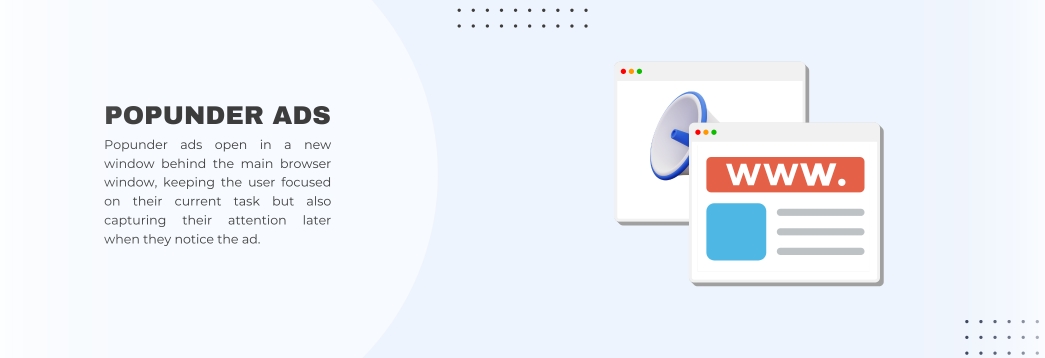
Pop-up and pop-under ads are types of ad formats that appear in separate browser windows or tabs, typically triggered by user actions or page loads. Pop-ups appear on top of the current web page a user is viewing, while popunders are displayed underneath, as their name implies.
One of their main perks is their non-intrusive nature, since they do not take up space on a website, thus they do not disrupt the user experience. Pop-under ads are considered even less intrusive than pop-ups since they do not disrupt the user’s immediate browsing session.
Successful Mondiad verticals: Being so non-invasive, pops are super versatile ad formats that can be used across various verticals and industries, including e-commerce, tech, travel, finance, or betting.
Video ads

Video ads are popular as an ad format since they come in various formats and lengths, and they can serve different advertising goals. As the name already suggests, these ads appear in video content, either before, during, or after the video(In-Stream Video Ads) and they can be skippable or non-skippable.
Similarly, there are Out-Stream Video Ads which appear within content but are not directly related to it and they often auto-play when in view. Lastly, there are also In-Display Video Ads which appear alongside other content, like on YouTube or in search engine results, and typically include a thumbnail image or title to entice clicks.
Successful verticals: Since they are so hard to miss and visually engaging, video ads can be used across all industry verticals, whether the goals to drive brand awareness, tell a story or drive user engagement.
Social Media Ads

Social media ads refer to paid advertising content that is displayed on social media platforms, including Facebook, Instagram, Twitter, Linkedin, Pinterest, TikTok, SnapChat, etc. They are widely popular and preferred for their extensive reach, precise targeting and familiarity with the social media landscape.
On another note, it is believed by many that social media has reached ad saturation and fatigue, causing users to tune out or become annoyed by repetitive content. Additionally, social media platforms frequently update their algorithms, which can impact the visibility and reach of your ads.
Successful verticals: When it comes to social media ads, things get a little tricky since not all verticals( for example, adult content or betting offers) are allowed and there also may be certain restrictions or guidelines regarding some niches.
FAQ
There isn’t a universal winner. The best-performing format depends on your campaign goals, target audience, offer, and industry.
Start by defining your objective (brand awareness, conversions, app installs, lead generation, etc.), then consider your audience, budget, and the type of experience you want to deliver.
Not necessarily. Many successful advertisers combine multiple formats to reach users at different stages of the customer journey and maximize performance.
Run your tests for at least two weeks to gather enough data before comparing performance metrics like CTR, conversion rate, CPA, and ROI.
Monitor click-through rate (CTR), conversion rate (CR), cost per acquisition (CPA), return on investment (ROI), and engagement metrics to identify your top-performing formats.
Yes. Every vertical behaves differently. What works well for finance may not perform the same for dating, e-commerce, utilities, or gaming, so niche-specific testing is essential.
Ready to find your best-performing ad format?
Launch your next campaign with Mondiad and test multiple ad formats from a single platform. With no minimum commitment, you can optimize based on real performance data and discover what works best for your goals.
Whether you’re focused on traffic, conversions, or brand growth, our team and platform can help you find the winning combination.